

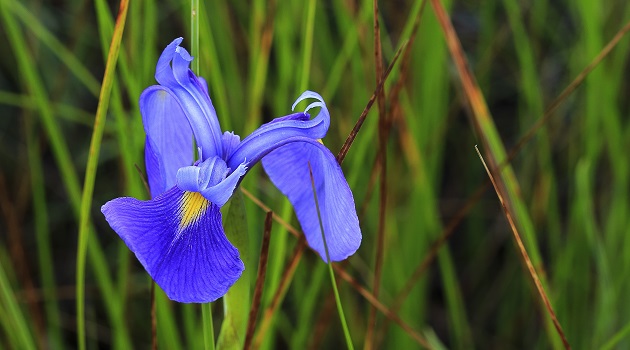
Photo: Blue flag irises carpet Red Bluff Bain in blue come spring.
By Tom Poland, A Southern Writer
TomPoland.net
The rains of late and spring’s approach set my mind on the Carolina bays, those coastal plain wetlands of mystery and life. The elliptical depressions are filling with water and the great amphibian breeding frenzy is ongoing. Few will hear the chorus in the truly wild, remote bays. It takes effort and will power to see them.
I spoke to a nature conservancy on the Carolina bays. I told them, “Man is the worst thing to happen to Earth.” From their silence I could tell they didn’t agree with me. Well, I’m right and they’re wrong. Need proof? As we continue to overpopulate, we expand interstates, level wilderness for housing developments, fill the seas with plastic, and in general create havoc for wildlife as we continue to subjugate wilderness to our will. Look how many weedy, abandoned strip malls you see, even as men build new ones only to be abandoned when urban rot comes along, and it will.
You don’t see man’s meddling in the remote, pristine bays. To go into a bay is to leave civilization behind. To go into a bay is to go into wilderness. It’s a place where, you, man, enter nature’s domain. It’s not like sitting in your backyard with its lawn, fountains, and flowerbeds watching birds and squirrels. They cope with your domain where signs of habitat tampering abound . . . pruned hedges and carefully laid out brick and stone walkways, storage sheds, and pools.
You won’t see signs of man in an undisturbed Carolina bay. Oh, you may see charred trunks and burnt grasses where prescribed burns duplicate lightning’s fire benefits. Prescribed burns, known also as controlled burns, manage weeds and invasive plants, lower wildfire risk, restore nutrients, and foster desirable plant growth.
You won’t see roads or structures or litter. You won’t see power lines or pipelines. You will see what in many ways are natural gardens. And birds. And pollinators. The wind carries the fragrances of wildflowers. Red Bluff Bay’s flowering plants and pitcher plants put on quite a show. Its colonies of green and yellow pitcher plants are glorious and hooded pitcher plants resemble the coloration of a doe — soft white spots against a tan background. Blue iris and white top sedge fleck the grasses with deep blue and white, and if you look closely a delicate green attends the white top sedge blooms. When you gaze across the tops of the sedges and grasses it’s as if you are peering through a layer of fog. It’s like peering into mists.
In a bay such as Red Bluff, you won’t hear lawnmowers, weed eaters, nail guns, and the trappings of civilization. You will hear birdsong whose only competitors are thunder, rainfall, frogs, and wind in the grasses and trees. It’s as beautiful a harmony as you can imagine. You’ll hear the pure call of the bobwhite quail. At night, you’ll hear frogs and owls. You’ll hear things you can’t identify. You are an intruder.
What you see proves significant. You can stand in Red Bluff’s savanna and trace the wood line until your eyes complete an elliptical path. True to form, the compass reveals that the bay’s axis runs NW to SE, as do all bays, a hallmark of the bays.
What you don’t hear is vital too. You won’t hear lawnmowers, weed eaters, nail guns, and the trappings of civilization. You will hear birdsong whose only competitors are thunder, rainfall, frogs, and wind in the grasses and trees. It’s as beautiful a harmony as you can imagine. At night, you’ll hear frogs and owls. You’ll hear things you can’t identify. Might even feel you don’t belong there.
It’s natural to feel a sense of mystery. You are an intruder in a world far beyond yours.