

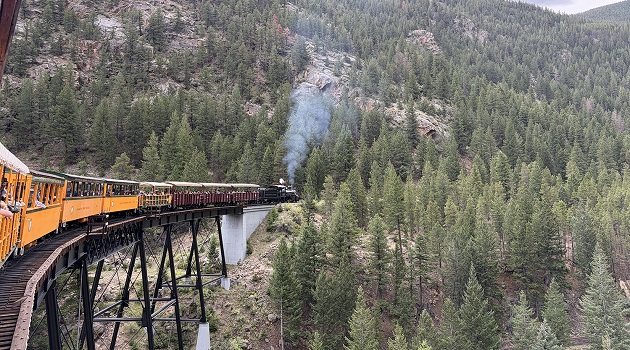
Crossing over Clear Creek. Photo by Katie Shugg
By Tom Poland, A Southern Writer
TomPoland.net
8-22-2026 — a day for numbers, a day to visit the Old West. From Denver’s mile-high air we took I-70 45 miles west to an elevation of 8,772 feet to board an 1884 steam train. We rode that corkscrewing train 406 feet up Republican Mountain more than three miles of three-foot-gauge track, crossing Devil’s Gate High Bridge 95 feet over Clear Creek along the way. At 9,178 feet we detrained to walk 600 feet into the Lebanon Silver Mine. In the dark, wet tunnel we stood beneath I-70 which runs to Utah 227 miles distant.
Driving west through Colorado the land goes from flat high plains to rolling foothills. Near Morrison slabs of red sandstone explode from the plains like whales lunging from the sea. Soon the Rockies wall off the west.
Arriving at the Georgetown Loop Railroad we hear gunshots and shouting. Desperados are robbing tourists. Undeterred, we advance. Here she comes, No. 40, our oil-burning locomotive. A whistle screams. We board, we chug along, that whistle a’blowing, steam a’hissing. “Petticoat Junction” worms its way into my mind and stays there.

Through aspen and conifers, by Clear Creek whose waters turn into beer, to the Lebanon Silver Mine. We detrain and get a safety talk from our guide. Mandatory hard hats. Mandatory head count, a no tourist left behind thing. Into the depths. Tight depths.
They carved the tunnel at an upward angle so water runs out. We sidestep a rivulet. In one place stalactites form. “Do Not Touch.” An eternity of dripping must pass before they merge with stalagmites.
The average 1880’s miner stood 5-foot-five. Stooping, I crouch-walk beneath beams that hold up a mountain . . . so the guide says. The claustrophobia is scary real. My chest tightens. I want to turn back.
The guide guides and talks. “Boys worked by candlelight, carrying stuff.” Powder monkeys, 12 to 14, lugged dynamite on their shoulder. Runners, 10 to 13, hauled dull drills and picks to the blacksmith and emptied the “necessary box.” By 15 a boy would be shoveling ore into small cars that ran on the mine’s narrow track. Shifts ran ten hours, six days a week at a temperature of 44°F year-round. Between sweat and dripping water, clothes stayed wet.
Accidents killed men. Their sons stepped right up to wrestle “the precious metal from the clutches of the miserly rock.” Families needed the money. They hauled $500,000 worth of silver ore out of the Lebanon Mine ($17,000,000 today). Their pay, less than $3 a day, was pretty good for then. Some pocketed high-grade ore to sell on the side. Some got shot for doing that. (At the chicken-tender age of 16, I worked in a poultry processing plant. I thought I had it tough.)
Tommyknockers, the spirits of men killed in the mine, alerted miners to rich deposits. They warned, too, of cave-ins. Nothing would save miners from silica dust. Its microscopic cuts formed scars that turned lungs to rock. Most miners died of silicosis by 35.
The 1893 repeal of the Sherman Silver Purchase Act crashed silver prices. That pretty much ended things at the Lebanon Silver Mine. The Tommyknockers didn’t see that coming. I, however, saw the light at the end of the tunnel.
I was glad to walk into daylight. Glad to board No. 40. Glad to roll past dark-eyed aspens. The thin Rocky Mountain air was clean and afternoon light bright, even more so after my stay in Colorado’s rocky entrails. It felt good to be back in that rarified Rocky Mountain air. Good to wear dry clothes. But that “Petticoat Junction” theme? It’s still doing a number on me.