

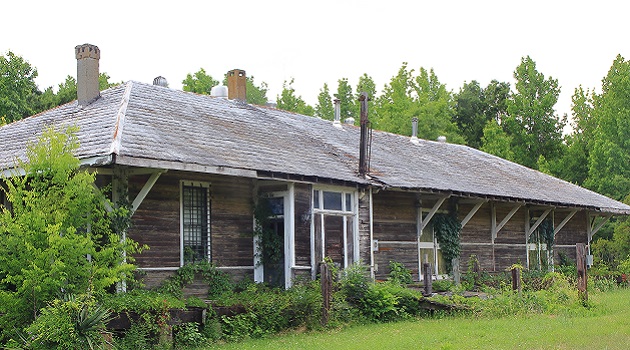
Where a $20 bush axe killed the music.
Jackson Station Rhythm & Blues Club
October 1977—April 1990
Where the music died.
By Tom Poland, A Southern Writer
TomPoland.net
Now and then a kind of gravity draws me to an old building. I’m driving south on SC Highway 25 near Hodges. Hurrying to get home before dark when I spot an old depot. No tracks. My steering wheel turns right. An old portable marquee rusts away in weeds. As I cross the parking lot a suspicion of tragedy rises. I stopped at an old store to photograph a gas pump years ago. That led me to write “The Mule Kick That Killed Eight People.”
This depot marooned in time and place. What’s its story, this depot without tracks, like a plane without wings. Back home, I googled “old depot Greenwood, South Carolina.” No luck. I tried “old depot Hodges, South Carolina.” Bingo. The depot had a second career, the Jackson Station Rhythm & Blues Club.
In no time I discovered the Station’s tragic ending. A fellow had too much to drink and slipped out without paying his tab. A good night got all crossways. Jackson Station Rhythm & Blues Club had summoned me to tell this blue tale. As with my “Mule Kick,” story a fellow had written a book about the place. It was déjà vu all over again, Yogi.
I asked Abbeville’s Ronnie Myers what he knew. Ronnie’s a former railroad man, musician, and friend. We went to high school together in Georgia.
“Lots of history surrounding this old depot,” Ronnie told me. “It was part of the first railroad line built in South Carolina, the Greenville & Columbia Railroad. Back in those days folks who lived in this area never saw the coast during their life simply because of the distance. Before the railroad it would have taken a month to make a trip to the ocean and back in a wagon but as one railroad owner said, ‘Today, a cock that crows in the morning in Greenville can be served that evening for dinner in Charleston.’
Ronnie set me straight on the missing tracks. “You won’t see any tracks, but the roadbed should still be distinguishable.” He would know. Ronnie performed at Jackson Station in the 1980s.
“It was unique being a trainman and singing in an old train depot. I felt like Jimmie Rogers.” (A country music pioneer known as “The Singing Brakeman.”)
Fame came calling. Widespread Panic played at the Station during the 1980s. Tinsley Ellis, Southern blues-rock guitar virtuoso came. The Legendary Blues Band, Muddy Waters’ backing band brought Chicago blues to the Station. The Swimming Pool Q’s, an Atlanta band brought a cutting-edge rock dynamic to the venue. An early version of the Georgia Satellites played there before finding mainstream success. Poco, a country-rock pioneer, also made a stop at the Station.
The Station’s two owners, Gerald Jackson and Steve Bryan were gay, and their club attracted all walks of life. Bikers, gays, college kids, the young and old. Strom Thurmond even threw a birthday party there for his wife, Nancy. The good times rocked on.
Then one of the South’s most iconic blues bars stopped on a dime. Gerald Jackson followed Terry Daniel Stogner into the parking lot to collect a bar tab. Stogner slammed Jackson in the head with a bush ax and left him for dead. Jackson, a Vietnam veteran, survived but was never the same. He spent the remaining 19 years of his life in the V.A. Hospital in Columbia. Convicted of assault and battery of a high and aggravated nature Stogner received 10 years in prison, serving less than seven. Jackson forgave his assailant.
Lander University professor Dr. Daniel Harrison wrote Live At Jackson Station — Music, Community, and Tragedy in a Southern Blues Bar, University of South Carolina Press.
“The musical talent you could get was incredible,” Harrison said. Jackson paid performers $500, pretty good money in those days. Harrison’s book tells how Jackson Station came to be, how it flourished, and how it faded into oblivion.
Key players in the Jackson Station tragedy are no longer with us. Then again, maybe they are. Something pulled me into the old blues haunt that day. When I go back, I expect to find an old guitar pick along the dripline. Maybe I’ll hear the Station’s lonely song again . . . The neon’s dark, the sawdust is still, Just ghost notes echo on an empty hill. The jukebox blew its final fuse, This battered old club’s got its own dead blues.