

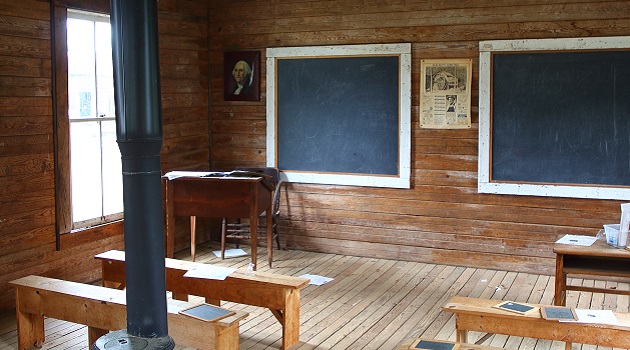
The one-room schoolhouse, legendary, and iconic.
By Tom Poland, A Southern Writer
TomPoland.net
I visited the Bart Garrison Agricultural Museum of South Carolina in Pendleton a few weeks back. If you’re a product of the rural South as I am, the museum takes you on a long walk down memory lane. Things my older relatives told me materialized right before my eyes. From a one-room schoolhouse with its quaint desks to old plows and seed sacks to an outhouse, memories aplenty came to me.
I didn’t see any old flour sacks, but when I saw some old seed sacks, the Depression-era words of my late Aunt Sister came to me. “Everybody had dresses made from bolts of cloth provided by the WPA so everybody looked alike.” She went on to say that she remembered how dresses were made from flour sacks. “They had to be washed a lot to get the numbers and printing out.”
Today, we use a phone to order the latest fashions which arrive at our front steps in no time at all. No washing over and over to get the printing out. No bolts of cloth. No sewing. No memories either.
Josh Johnson, curator, led me through the museum. He enlightened me on something I had no clue about whatsoever. Before it made cars, Studebaker made wagons. The wagon looked sturdy, strong enough and well-built enough to navigate the Great Wagon Road.
Josh gave me the chance to check an item off my bucket list. I held a Cherokee bow. The real deal. The craftsmanship behind that bow was excellent. The bow was found up near Oconee Station, an old fort that protected pioneers from Indian raids.
Not far from the bow a glass case held an old powder horn. Some folks may be unaware just how important those old powder horns were. Farmers fought in the Revolutionary War, and the powder horn symbolized their Patriot-farming-fighting ways. Sawed-off from cattle, those powder carriers were lightweight and watertight. The easy-to-pour, easy-to-wear powder horn kept soldiers’ gunpowder dry in all weather conditions. And it didn’t create perilous static electricity sparks. With a plow in one hand and firearm in the other, Patriot farmers helped win the Revolutionary War.
Moving on from weapons, I saw an old Fairbanks-Morse generator. From the 1920s through the mid-20th century, these diesel engines drove generators that supplied primary power before commercial electrical grids arrived. I remembered how Mom talked about the first family to get electricity in her area. “People gathered on Saturday nights to sit in a circle and stare at the one lightbulb hanging from the ceiling.”
More than anything the little one-room schoolhouse spoke to me. I taught one year of public school. One of my classrooms was an annex, a modern version of the one-room schoolhouse. The students and I made do. That’s the best way I can put it. No TV, no computers, and a greenboard I believe, no blackboard. Unlike the old days, nobody danced to the tune of a hickory stick.
A bag of otter skin reminded me of a historic community back home in Georgia that dates back to the late 18th century. It’s believed to be the first leather tannery in Georgia, if not the entire American South. An early settler, Balaam Bentley, established it. Because of the leather tannery, the area became known as Leathersville, a center for hand-made shoes and harnesses surrounding counties needed.
Like I said the museum took me on a long walk down memory lane. If you like the old days and ways as I do, visit the Bart Garrison Agricultural Museum of South Carolina in Pendleton. You’ll be glad you did.
We’re losing the small farm aspect more than ever. The museum preserves aspects of those days. Be advised that the museum opens from 10 am until four pm, Thursdays, Fridays, and Saturdays.