

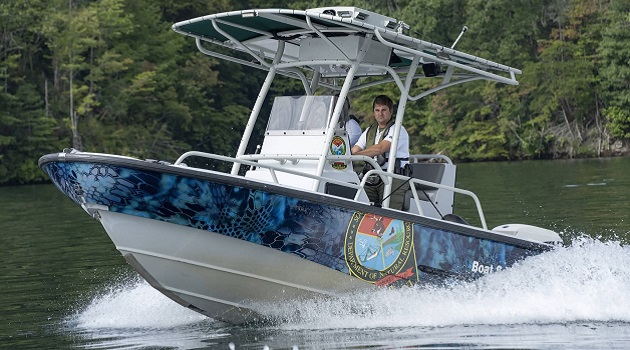
SCDNR Director Tom Mullikin is aggressively going after environmentally dangerous
abandoned watercraft and their former owners
By W Thomas Smith Jr.
Earlier this month, the S.C. Department of Natural Resources (SCDNR) under the “commanding leadership” of Dr. Tom Mullikin targeted yet another abandoned vessel – a 60-foot barge – in S.C. waters, specifically off the coast of James Island near the Atlantic Intracoastal Waterway at Wappoo Cut (aka Wappoo Creek). The discarded barge, left to decay in shallow water, was more than simply an eyesore: It was both an environmentally dangerous threat to humans and marine life as well as a navigable hazard especially to boaters at night.
Tom Mullikin was having none of that. In a May 19 article that has since been published nationwide, Mullikin flatly stated: “When I saw this vessel for the first time I immediately knew it had to come out … and it had to come out now. Removing this vessel and others like it is absolutely vital to protecting the health of our marshes, waterways, and coastal communities.”
Since 2022, SCDNR and its partners have removed nearly 230 abandoned vessels from S.C. waters, including 62 boats which have been removed since Mullikin assumed the reigns of SCDNR in February 2025. The difference today being that Mullikin is not only ridding Palmetto State waters of these serious threats to the environment and public safety, he is going after the perpetrators who somewhat cavalierly abandon these often-sizable wrecks wherever they may.
“No longer! Period, end of story,” says Mullkin, a renowned global expedition leader, attorney, and retired military officer who in addition to serving as SCDNR’s director is also the department’s ranking law enforcement officer.
“I’ve had enough of this!” he says.
Therein lies the aforementioned commanding leadership.
In August of last year, a 120-foot abandoned U.S. Navy torpedo-retriever boat was pulled from Bohicket Creek near Johns Island. That removal generated quite a bit of media coverage, but it wasn’t simply the removal of that boat that spawned all the coverage: It was the fact that the abandonment and subsequent investigation also led to the first arrest made under the state’s recently enacted abandoned boat law, authored and championed by S.C. Senator Chip Campsen.
That law, effective exactly one year ago this month (May 5, 2025), states: “It is unlawful for a person to cause or allow a vessel to become an abandoned vessel or a derelict vessel.” Further, “It is unlawful for a person to intentionally or recklessly cause a vessel to sink on the waters of the State.”
Though deemed a misdemeanor, the penalties are stiff and include heavy fines and imprisonment if convicted.
“We’re not simply pulling these terrible looking, navigably dangerous, environmental threats from our waters,” said Mullikin. “We are pursuing those who left them there to decay.”
Prosecuting bad guys – and make no mistake, those who abandon watercraft for somebody else to deal with are not at all good guys – is not new to Mullikin who brings decades of law enforcement and prosecutorial experience to SCDNR.
Admitted to practice law before the South Carolina Bar, the Fourth Circuit Court of Appeals, and the U.S. Supreme Court, Mullikin has worked extensively in matters involving environmental law, national security, and governmental accountability: Not to mention his military service – a JAG officer (literally a prosecutor) in the U.S. Army and a retired two-star commanding general of the S.C. State Guard – Mullikin also served in a civilian capacity as Special Assistant to the Chief Prosecutor of Military Commissions overseeing the prosecution of terrorist mastermind Khalid Sheikh Mohammed and four 9/11 terrorist co-defendants.
Beyond that: Mullikin has for years surrounded himself with sterling thought-leaders from the various military special-operations communities like retired Navy SEALs and former Marine Recon operators with FORCE BLUE and so many others who have assisted him with everything from the S.C. Floodwater Commission, which he chaired beginning in 2018, to his self-conceived SC7 Expedition from the mountains to the sea.
Today, the SCDNR director’s law-enforcement background includes service as a certified South Carolina State constable, a special deputy with the Richland County Sheriff’s Department Underwater Recovery Unit, and currently as a certified Class I Law Enforcement Officer with SCDNR where he often works alongside emergency management and homeland security organizations, collaborating with local, state, and federal law enforcement leaders across S.C. Few know any of this, but Mullikin’s success in targeting those who would harm us “is sufficient reward in-and-of itself,” he says.
And as far as those who think they can discard vessels, perhaps secretly, to rot in South Carolina waters, they frankly don’t know who they’re dealing with.
– W. Thomas Smith Jr. is a formerly deployed U.S. Marine Infantry leader, an award-winning combat correspondent, and a New York Times bestselling editor. Visit Smith online at http://uswriter.com.