
By Liesha Wessinger-Huffstetler
Who owned the land in the town of Chapin in the 1750’s? Great question.
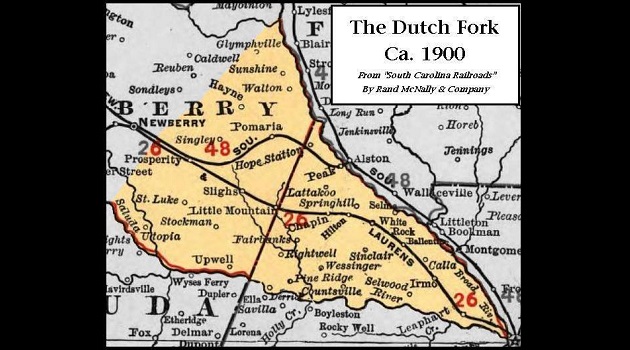
It was not Martin Chapin. John Bigham, in a Chapin Times article, interviewed Mrs. Llewellyn Pearce, granddaughter of Martin Chapin. She said that Martin Chapin first moved to Columbia from New York in 1850. In 1752, German immigrants received a King’s Grant for land in the backcountry of the Carolina Colony. Where did “Dutch Fork” come from? It was named that because the “Deutsch volk,” the German folk, lived between the forks of the Saluda and Broad Rivers. This area extended into areas of Newberry, Lexington, and Richland counties. All the 1752 original German families’ ancestors owned King’s Grant land in these areas.
A big thank you to Betty Bundrick and the late Carl Nichols for their hard work in creating this map, which she gave me. Here are some of the names of the original immigrants who owned the land in and around the town of Chapin.
From the center of town to the interstate, the land was owned by John Miller, Peter Boyer, George Swygert, Jacob Roll, Daniel Lindler, and Jacob Cook. Coming down Highway 76, Adam Gramaker, Francis Koon, Adam Haltiwanger, Jacob Epting, John Busch, and Michael Leitner. If you travel down St. Peter’s church Road, you will find Matthias Quattlebaum’s land grant of 750 acres. Lawrence Feagle, George Litsey, Abraham Chapman, and Matthias Quattlebaum owned land down Amick’s Ferry and including Sand Bar Road. Down Old Lexington Highway, Charles Mc Cleland, Adam Haltiwanger, John Livingston, and Edmond Bellinger owned all the land to the lake. A family of three received a minimum land grant of 150 acres, with each member getting fifty acres.
Where are these families today? Some of these families sold their land and moved away. Land from “Loyalists” were given to those in who fought on the side of the Patriots. John Adam Summer, my ancestor, who lived in the Pomeria area, ended up owning hundreds and hundreds of acres in the Dutch Fork after the war in recognition of his essential role in the war for our freedom. The names of the roads tell you who lived in the area. An older relative, James Franklin Wessinger, told me the original name of Wessinger road was “Gilbert Hollow” because it went to Gilbert. However, the man working with the roads project in the 1930’s renamed it Wessinger road because all Wessinger’s lived on the road. Why did King George want a colony in the uninhabited woodlands of the Carolina Colony? It was because he had Charleston on his mind. The King had to have a colony in the backcountry to help protect Charleston, the German immigrants were his answer.
Photo from Dutch Fork Historical Society