

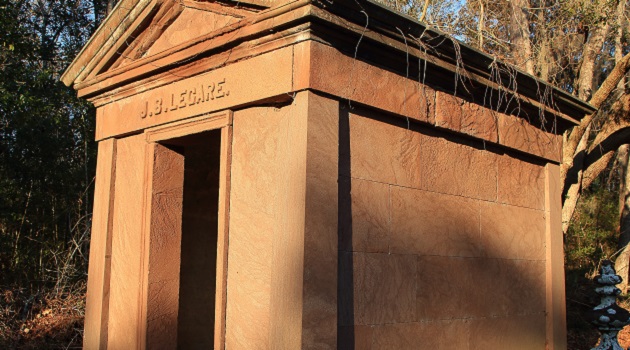
The cursed door no longer seals the mausoleum
By Tom Poland, A Southern Writer
TomPoland.net
A road down Edisto Island way will take you past green swamps and oaks dripping with Spanish moss and shanties with bright, sky-blue doors. Churches white as egg whites line the road. Hauntings live there.
As you spirit across ancient seabed among the ghosts of cruising sharks and skittering blue crabs you’ll pass the Edisto Island Presbyterian Church. People have been laid to rest in the churchyard since 1797. Among them is Julia Legare, who died on Edisto in 1852, age 22. They buried her alive . . . so the story goes.
Can you get past what Cormac McCarthy wrote? “How surely are the dead beyond death. Death is what the living carry with them. A state of dread, like some uncanny foretaste of a bitter memory.”
I carry it and maybe you tote it too. “Tote,” what a fine word. Tote that fear of death but maybe a worse fate exists.
1992 — In the last strong light of a winter afternoon when the Spanish moss seems more alive than its oak hosts, I was working on a book. I stopped at the Edisto Island Presbyterian Church. An aura of mystery intensified the moment I stepped into the cemetery. The call of a barred owl, anticipating nightfall, floated over from mossy woods. It gave me a chill. I knew nothing of Julia Legare back then.
February 9, 2026, on the way to a book event I stopped at the church again. Stepping from my car I saw the Legare mausoleum. From the Edisto Beach website: “Back in the mid-1800s, Julia Legare was visiting family on the island when she became ill and slipped into a coma. The family physician declared the young girl dead. Fifteen years later, another death required the mausoleum to be opened. Julia’s remains, which had so long ago been entombed, were crumpled at the foot of the mausoleum’s door. She had been buried alive.”
There was a time when folks would sit up all night with the dead. They looked for a sign. Breathing. Movement. Something. Today the departed send their last night on earth alone, sad to say. I keep three memories in a shadowy corner—the three corpses I viewed in their home. One was a teenage boy who played the trumpet in the high school band. He died of brain cancer. I see his pale face now and a whisp of hair dead center his bald scalp like some shrub stranded in a salt flat. Bobby was his name.
One was my great grandfather. He wore glasses to see his way to whatever destiny awaited. I recall thinking he was deader than dead, so pale was he. Talmadge was his name.
The last was my granddad. I saw him in a suit just twice. At a wedding and in his coffin. I asked Carlton, the funeral director, how long Granddad would look that way. “Fifty years,” he said. That was fifty-four years ago. Folks called Granddad Johnny. He made the best moonshine in the county and could cuss up a storm.
In the old days, someone sat by the departed one until the body was lowered into its resting place. If the dead soul stirred, someone could save them from their own funeral. Another reason was to keep rats away.
Folks hung bells inside coffins. A string tied to a hand ran through a pipe protruding above ground. Bells were put to use in mausoleums. Who will be there to hear your bell?
The day I stopped by a man was scrubbing a monument close by the Legare mausoleum. He told me he was from New York.
“I come down here to get away from the cold.” I mentioned Julia Legare. He laughed. “Yeah I hear it was a girl. I hear it was a woman.”
The “cursed” door was gone. I read that visitors and caretakers reported finding the massive marble door wide open, even when it had been chained or locked. After many attempts to secure it failed, they removed the door.
I worked on a story about a man who defrauded elderly women of millions. An attorney had this to say. “When that son of a b—- dies, someone needs to climb into the coffin and drive a silver spike through his heart to make sure he’s dead.”
If they bury him alive, he’ll suffer the fate of Edgar Allen Poe’s narrator in “The Premature Burial,” a man who struggles with catalepsy, he randomly falls into death-like trances. “True wretchedness,” he fears, “is to be buried alive.” That would outdo a silver spike, don’t you think.