

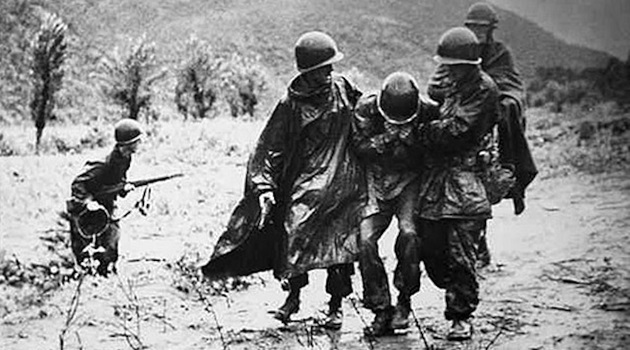
Photo: Army Chaplain (Capt.) Emil Kapaun (right) and Army Capt. Jerome A. Dolan, 1st Cavalry Division, carry an exhausted soldier off the battlefield in Korea, early in the war.
By Dennis H. Klein and Wade Thompson
The Korean War lasted for 3 years (1950-1953) and was a war between North and South Korea. Backed by US forces the conflict killed millions both military and civilian and took 36,000 American military lives. The armistice created the Demilitarized Zone on the 38th parallel which still exists today. There was no official peace treaty between the North and South so the two Koreas are technically still at war.
These stories are about the period that has been called the Second Korean War (1966-69) because of the hostilities that were taking place. It was not published in newspapers or media at the time. The government didn’t want more possible hostilities known due to Vietnam being such an unpopular war. These are first hand accounts from veterans who were there.
2nd Korean [DMZ] War ’66-’69 81 U.S. KIA 397 KATUSA KIA
So carefully kept out of history
Communism Contained, S. Korea Zooms to World Power Still Loving US
Excerpt from Unremembered Victory
Available on Amazon.com
This is a distillation of a story in the book Unremembered Victory about a never-before-road to the most remote guard post on the highest ground in the Korean DMZ in ’68. Dan Schikevitz is the author, his mom’s maiden name [Pinus Point, Virginia]. Ahead is a tale about a ‘Right Fight’ Victory way too far off the narrative of military-defeat-manufactured shame to be included in history. Told by a Civil Engineer’s son, tale is a childhood fantasy come to life – armed Combat Engineer Officer, facing the fire, roads and bunkers to win a war.
A Road to the Top
PART I
Just two days after January 23, 1968 when the USS Pueblo Spy Ship was seized and 400,000 North Korean soldiers massed above just our 4,000 on the Line, threatening invasion, Lt. Dan Schikevitz’s assignment was to recon every road to every Guard Post in the Korean DMZ and report back on their condition and needed improvements. Boring enough but for one, Guard Post Gladys, for which there was no road at all. The only way up was to backpack supplies along a near vertical hand-over-hand trail. Rapid reinforcement by motorized vehicles had never been possible before or after the Armistice in ’53 when they froze the Line. Dan turned in the report and by the end of the week he was ordered to engineer a road to GP Gladys, pronto.
Luck of the draw for Dan, and perhaps the world, due to a failed critical works draft deferment, prior to conscription, he had worked seven months for the LA Mountain Roads Division, up to his eyeballs in topo maps, citing roads up mountains. Now as OCS trained 8th Army, 2nd Infantry Division, 2nd Combat Engineer Battalion Officer, he was not guessing. Particularly steep, this ridge was clad on both sides by ‘ribs’ divided by steep ravines. Most of the ribs started off gentle enough, all had a steep part somewhere that would require a lot of blasting. Dan knew from the get-go that the easiest way up was finding the tail of ridge’s backbone. Just his luck, that was in North Korea, so he had to settle on a route not quite as good as it gets, but at least in friendly territory.
Who could imagine? Before the ‘shooting started’ not that long ago, the whole 2nd Infantry Division was dismissed as a friendly-fire-death contest. After the Pueblo, not ONE [accidental death due to low morale and collapsed procedures].
More about “shooting”, 4,000 soldiers stood on each side of the Line, by armistice rules, handheld weapons only and a few tanks. American patrols searched for enemy infiltrators, while North Korean infiltrators on our side of the Line ambushed patrols and/or assaulted guard posts. In [almost] all cases, the North Koreans shot first and we returned fire—sometimes nervously, sometimes quite decisively. Regardless, from February – August ’68, day and night on the DMZ, random shots to concerted firefights, were to be heard nearby or far away all the time, killed in action: 80 US 135 KATUSA – [Whole DMZ]
So what caused this smoke-and-joke flip to the Army-of-the-Republic. Just days before Dan started his road recon, 31 North Korean Commandos slipped through the anti-infiltration fence, watched by two US Army soldiers who did not report it so ‘they would not get in trouble’. The Commandos get within two blocks of assassinating SK President Chung He Park the next day, while the USS Pueblo spy ship, not even put on alert, is seized on the high seas [still held] the same day the 400,000 arrived in the trucks. Why? Forcing the SK White Horse and Tiger Divisions to leave Viet Nam to come home to protect the homeland, ending all possibility of winning the Viet Nam War.
Every ‘right fight’ has great leaders, in this one, 4 Star 8th Army General Bonesteel, Rhodes Scholar, who grants 2 Star 2nd Infantry Division General Izenour permission to give hard orders. Within hours, Izenour relieves 3-Brigade Colonel for just 2 guys asleep on duty with orders not for him to sleep in Korea that night. He did not. Cause and effect, two days later, on the road along the Anti-Infiltration Fence, when Lt Schikevitz falls backwards slightly when saluting a passing full Bird Colonel, out of a cloud of dust kicked up by the screeching-to-a-halt jeep emerges a 6’-4” great looking Colonel screaming almost 3 minutes of endless, non-repeating epithets at Dan about how beyond redemption the situations is being stuck only with officers this sorry laced with surely impossible challenges to do better.
Knowing you are not taken to the gates of hell for a bad salute, Dan took it as TRAINING and immediately visited the seven man up-until-then ‘bozo’ survey team that reported to him. Recording alignments of the combat roads north of the fence subject to enemy assault at any time, they thought funny to not be ready for an assault [helmets, flack jackets, weapons and ammo all in the truck]. Dan enters screaming . . .
‘OK. You get hit. No helmet. No flack jacket. Your weapons are in the truck, who knows where the ammo is. Joe opens up. You’re all killed. You’ve got it easy. YOU’RE DEAD’ and I have to live with it for the rest of my life. I’m not just doing it. You will be ready … etc. All day every day.
It will actually take more hard orders for this crew to stop being bozo, but that is for the next installment about how a road to the top of a ridge sped the end of an armed conflict, the secret weapon being Hard Orders smashing them, from top-to bottom, into seamless universal trust, there is no stronger force.
Each day the flagging operation was AMAZING. Every minute Dan and his jeep driver/assistant were protected by a cordon of five riflemen, three American Army soldiers and two fully integrated South Korean soldiers with Sargeant Wade Thompson from Meridian MS in charge. Like ballet, when Dan moved to place the next flag, they moved, each time setting up perfect fields of fire so no one could get off a shot without coming through them. Wade was on the deal, ready to give his all to every task, as all the other US troops North of the Imjin [in the DMZ], full-time watching out for the welfare of all others, Wade, was signed up, like all others, for . . .
Let’s go over it again. I’m dead, but everybody else on my street, and in my town, and all over the world get to do what they want rather than what they’re told, perhaps even more than before. I’m all in.
Dennis Klein is a Bay Area civil engineer and digital mapping pioneer. A University of Maryland graduate and former Combat Engineering officer on the Korea DMZ, he later earned his master’s degree at UC Berkeley and built a career in regional planning. In 2002 he launched the first online national parcel map, a foundation for his current work with UCIP Services promoting universal parcel indexing for the real estate industry.
Wade Thompson, originally from Meridian, Mississippi, is a U.S. Army veteran now residing in Irmo, South Carolina. He served in Korea from April 1967 to May 1968 with Headquarters and Headquarters Company, 1st Battalion, 9th Infantry Regiment, 2nd Infantry Division—first in the Communications Platoon and later as the Commanding Officer’s driver. His duties placed him near Guard Post Gladys on the 38th Parallel, a connection the two men rediscovered nearly fifty years later. Their renewed conversations in 2016 revealed that they had served together during the tense period now known as the Second Korean War. Thompson previously contributed to a work by author Bob Kern, and Klein later invited him to write several chapters for the book Unremembered Victory.