

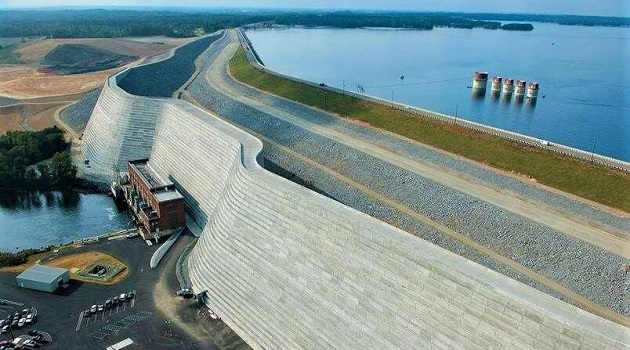
A minor earthquake shook the Irmo area around 6:45 p.m. on Friday the 13th, triggering a surge of 911 calls and prompting questions about the safety of the Dreher Shoals Dam.
According to the South Carolina Department of Natural Resources, the quake registered a magnitude 2.8 and occurred approximately two miles below ground, about three miles from Irmo.
“It sounded like a huge explosion,” said one resident. “There was a loud boom and then a rumbling like thunder in the distance.”
The 2.8 magnitude event is the largest recorded in South Carolina so far this year. A second, smaller quake measuring 2.0 magnitude was reported near Irmo around midnight on Sunday, Feb. 15.
Dreher Shoals Dam Safety
The earthen Dreher Shoals Dam, which holds back Lake Murray, includes a 215-foot concrete-and-rock backup dam completed in 2005. The reinforcement project was designed to withstand a catastrophic seismic event, including earthquakes of magnitude 7.0 or greater.
Officials indicate that the combined structure of the original earthen dam and the reinforced backup dam makes a breach highly unlikely, even in the event of a significantly stronger quake. Lake Murray contains nearly 700 billion gallons of water.
Why Earthquakes Occur in the Carolinas
Earthquakes occur along faults within bedrock, typically miles beneath the surface. Much of the bedrock beneath the inland Carolinas formed 500–300 million years ago when ancient continents collided to form a supercontinent, uplifting the Appalachian Mountains. Additional formations occurred about 200 million years ago when that supercontinent rifted apart, eventually creating what are now the Atlantic Ocean and portions of the northeastern United States and Europe.
While earthquakes in the central and eastern United States are less frequent than those in the West, they are often felt across a much broader area. East of the Rockies, seismic waves travel more efficiently through older, denser bedrock.
For comparison:
-
A magnitude 4.0 earthquake in the eastern U.S. can be felt up to 60 miles from its epicenter.
-
A magnitude 5.5 event may be felt as far as 300 miles away and can cause damage within roughly 25 miles of its source.
Though Friday’s quake was minor and caused no reported structural damage, it served as a reminder that seismic activity, while infrequent, is part of the region’s geological history.
Photo from West Metro News